
Daily market brief ·
Dell's revenue doubled. Why did the stock drop?
Blowout artificial intelligence sales are no longer enough to satisfy Wall Street. Here is why fears over chip shortages, corporate debt, and interest rates are pushing traders out of big tech.
The Dell paradox
On paper, Dell Technologies delivered the kind of quarter that usually sends a stock soaring. The computer and server maker reported fiscal third-quarter revenue of $54.9 billion, up 103% from a year earlier. It also revealed a record $132.3 billion backlog of orders for its artificial intelligence servers and raised its full-year revenue outlook to $202 billion.
Yet on Wednesday, Dell shares fell around 5%. In the middle of a booming AI hardware cycle, doubling revenue was not enough to keep buyers interested.
Dell was not alone. Chip giant Nvidia dropped as much as 9% in early trading before closing down 3.9%, erasing the last of Monday's relief rally after Jensen Huang was reinstated as chief executive. Memory chip makers Micron Technology and SanDisk also slid 4.53% and 5.57%.
No longer growth at any price
The cold reaction to Dell's numbers shows how much the mood on Wall Street has changed this autumn. On Wednesday morning, the tech-heavy Nasdaq 100 index plunged nearly 4.7% intraday. That drop briefly pushed the index 20% below its early October peak, the traditional threshold for a bear market, before late buyers trimmed its closing loss to 0.64%.
Over the autumn rout, the Nasdaq 100 has shed more than $8.5 trillion in market value. For months, investors bought anything connected to the AI buildout. Now, they are questioning how much all that computing equipment costs and when it will pay off.
A tougher economic backdrop is making those questions more urgent. The October Personal Consumption Expenditures price index, the inflation gauge favored by the Federal Reserve, America's central bank, rose 3.8% from a year earlier. Core PCE, which leaves out volatile food and energy costs, climbed to 3.3%, while third-quarter US gross domestic product growth was revised up to an annualized pace of 4.3% from 3.4%.
With inflation sticky and the economy running hot, futures markets priced in a 97% probability that the Fed will raise interest rates at its December 8-9 meeting. Higher rates make future tech profits less valuable today. Meanwhile, new US Section 301 tariff proposals of 15% to 35% across 14 trading partners and a 3.5% jump in Brent crude oil to $94.61 a barrel after a reported drone attack on Saudi Arabia's Ras Tanura refinery added fresh cost worries.
Chip shortages and AI debt
Beyond interest rates, two concrete problems are hitting the AI trade: physical supply bottlenecks and heavy borrowing. Edge AI chipmaker Ambarella plunged 19.77% on Wednesday after forecasting fourth-quarter revenue of $70 million to $75 million, a sharp drop from the previous quarter.
Ambarella's chief executive, Fermi Wang, blamed an unprecedented rise in memory chip prices and worsening supply scarcity. When critical parts like memory chips become too scarce and expensive, customers have to cut back their orders, putting a hard ceiling on near-term growth.
At the same time, Wall Street is taking a closer look at how the AI boom is funded. Newly public AI lab Anthropic traded below its $83 offering price on Wednesday morning amid reports that its planned bond sale may be rated below investment grade. A lower credit rating means a company has to pay higher interest rates to borrow money.
Central bankers are noticing the borrowing binge too. South African Reserve Bank Governor Lesetja Kganyago warned on Wednesday that massive debt issuance by huge US tech companies to build data centers is competing directly with governments for long-term cash, pushing up borrowing costs around the world.
The rotation into everyday value
While expensive AI stocks struggled, the rest of the market staged a remarkable pre-holiday comeback. After early panic pushed the Cboe Volatility Index, Wall Street's fear gauge, above 33, bargain hunters stepped in. The Dow Jones Industrial Average erased an intraday drop of more than 1,100 points, swinging nearly 1,270 points off its lows to close up 0.33% at 50,182.95.
The broader S&P 500 pared a 3.2% plunge to finish down just 0.25% at 7,182.78, with 370 of its 500 stocks ending the day higher. The Russell 2000 index of smaller companies gained 0.71% to 2,704.06 as money flowed out of crowded tech trades and into homebuilders, materials, and industrial companies.
Even inside the technology sector, investors favored steady profits over flashy buildouts. PC and printer maker HP Inc. surged 11.49% after beating fourth-quarter estimates and forecasting fiscal 2027 adjusted earnings of $3.15 to $3.45 per share. Alongside a rush into the safety of government bonds—which pushed the 10-year US Treasury yield down for an eighth straight session, its longest streak of declines since 2024—the message was clear: predictability is back in style.
US stock and bond markets are closed on Thursday for Thanksgiving and reopen on Friday for a shortened session, with stocks closing at 1:00 p.m. Eastern Time and bonds at 2:00 p.m. With fewer traders at their desks, thin holiday volume can exaggerate price swings as the market watches to see if Wednesday's shift toward value and smaller companies holds up before the December Fed meeting.
More from the blog
-
Daily market brief ·
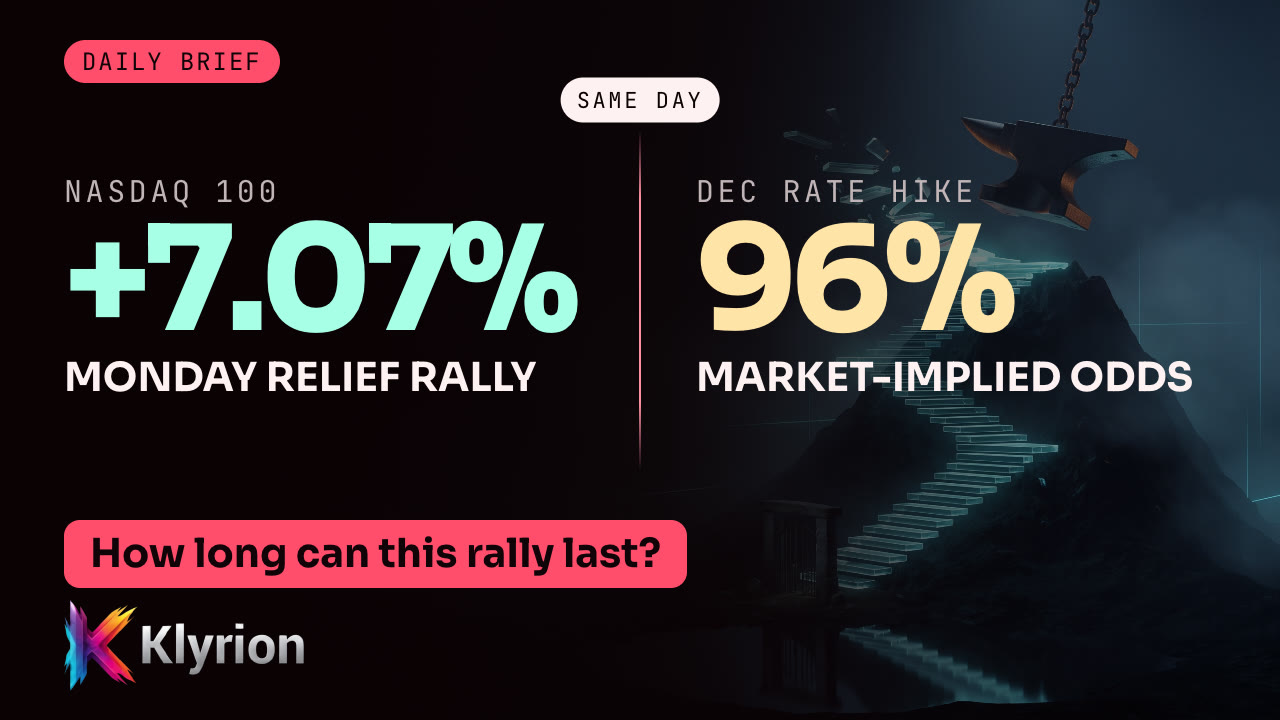
A 7% Tech Rally, 96% Rate-Hike Odds. What Gives?
Nvidia's surprise leadership U-turn ignited a massive tech rebound on Monday. Yet stubborn inflation fears keep a December interest rate hike firmly on the table.
-
Daily market brief ·
Can a $1.5T IPO Save the AI Trade?
Big money just backed the largest stock debut in history, even as high interest rates punish other artificial intelligence names. Here is why Wall Street is suddenly splitting the sector in two.
-
Daily market brief ·
Chip Stocks Tanked. Why Is Anthropic's IPO Booming?
Semiconductor makers tumbled on new export rules and boardroom turmoil, yet big investors are lining up for the next artificial intelligence giant. Here is why Wall Street is getting picky rather than walking away.